Working With Nature Instead Instead of Against It
What Fly Season Taught Me About Working With Nature Instead of Against It
Around here in Northern Illinois, you can practically tell the exact day summer arrives.
One good rain, the humidity cranks up, and suddenly it feels like you're breathing through a warm washcloth every time you step outside.
And just like clockwork, the flies show up.
The horses start swishing their tails nonstop, making a beeline for the run-in shed, and looking at me like, "Well... are you going to do something about this?"
Our herd is on the older side these days, and I'd much rather see them spending their energy grazing than playing defense against every buzzing insect in the county.
If you're a horse owner, you've probably stood in the fly-control aisle at your local farm store holding two different bottles, wondering which one is actually worth bringing home.
I've been there.
More than once.
But years of working around animals taught me something that's shaped the way I approach almost everything:
Before you reach for a solution, understand the problem.
Nature usually leaves clues.
When we slow down long enough to notice them, we often discover there's a better way to work with nature instead of constantly trying to overpower it.
Not All Flies Play by the Same Rules
Let's start with those giant horse flies.
You know the ones.
They sound like tiny helicopters, have zero respect for personal space, and somehow always know exactly which horse to torment.
The truth is, there isn't one magic spray that makes them disappear.
That's why our barn routine includes more than just a bottle.
Fans
fly sheets
good pasture management
and giving the horses places to escape the bugs all play a part.
I've learned that fly control is almost always about layers—not one miracle product.
Your Horse Is Constantly Sending Signals
One thing I find fascinating is how insects seem to have an incredible ability to locate animals.
Every horse is constantly breathing, moving, generating body heat, and interacting with its environment.
Some insects are remarkably good at detecting those natural cues.
(Honestly... the same goes for us. Mosquitoes certainly know how to find me. 😂)
Understanding that changed the way I started thinking about fly season.
Instead of asking, "How do I kill every bug?"
I started asking,
"How can I make my horses a little less inviting?"
That simple shift completely changed my approach.
Why I Enjoy Using Plant-Based Products
One of the reasons I enjoy using essential oil-based products around our barn is because they fit with the way I try to care for our animals overall.
I like choosing products inspired by plants whenever it makes sense for our family and our animals.
For me, they're simply one more tool alongside good management practices like clean stalls, manure control, airflow, fly sheets, and plenty of fresh water.
There isn't one product that does everything.
But I've found that thoughtful routines often make a much bigger difference than constantly chasing the newest miracle solution.
A DIY Blend That Inspired Me
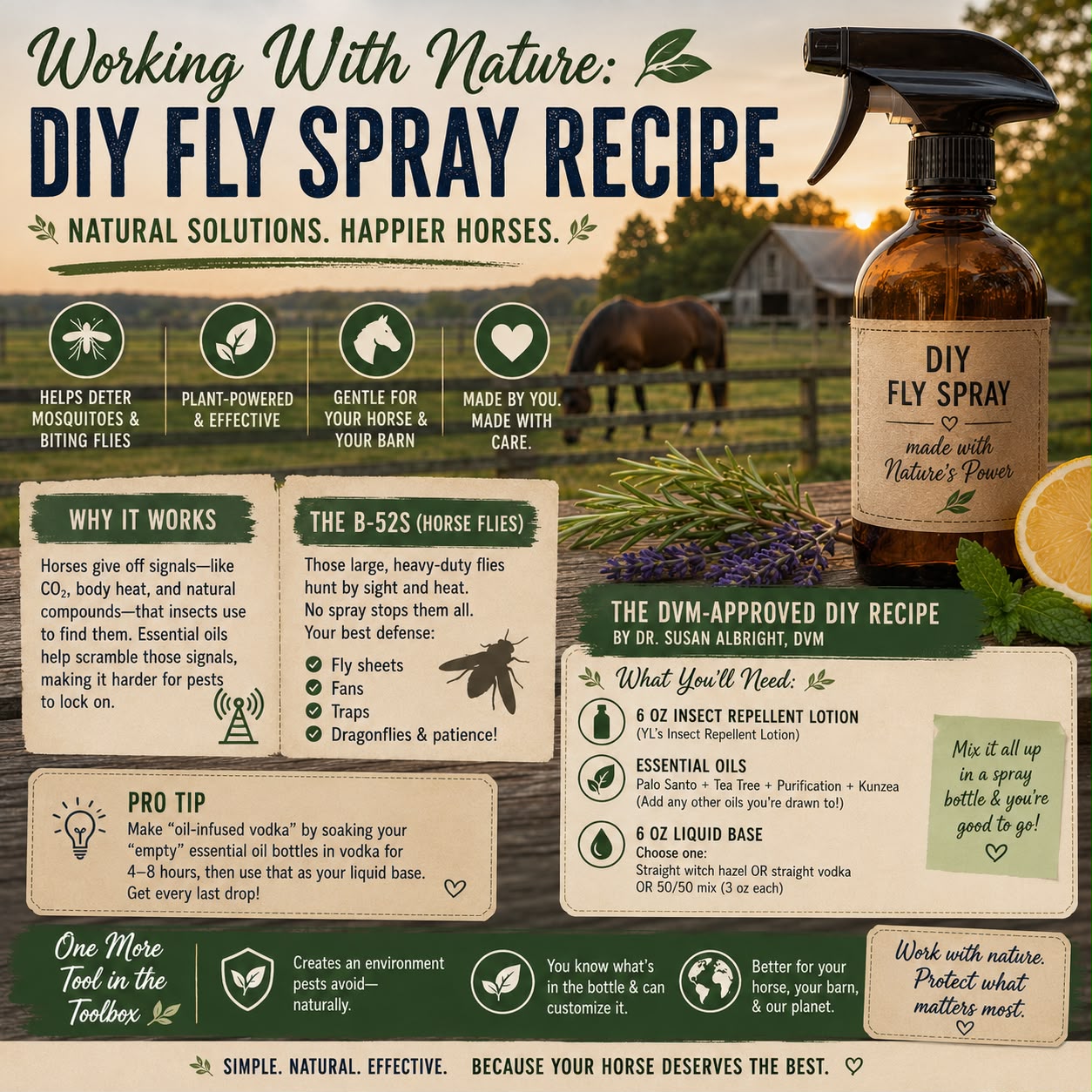
Several years ago, Young Living offered a product called Repel Aroma Spray, and a lot of horse owners absolutely loved it.
Although it's no longer available, I recently came across a discussion from veterinarian Dr. Susan Albright about ways she likes to build on Young Living's current Insect Repellent Lotion using additional essential oils.
I appreciated her perspective because it reinforced something I already believe:
Sometimes we don't need to reinvent the wheel—we simply adapt as products evolve.
If you enjoy making your own barn products, her ideas offered some great inspiration.
The products I personally keep on hand include:
Young Living Insect Repellent Lotion
Witch hazel as a spray base
Essential oils like Tea Tree, Purification®, Palo Santo, and Kunzea
Every horse, every environment, and every owner is different, so I always encourage doing your own research and choosing what works best for your situation.
Fly Season Is About More Than Spray
The older I get, the less interested I am in finding one perfect answer.
Whether it's caring for our horses, our homes, or even ourselves, I've found that lasting results usually come from stacking lots of small, thoughtful habits together.
Good nutrition.
Clean water.
Pasture management.
Airflow.
Rest.
Fly sheets.
And the products we choose to use.
Each one contributes a little.
Together, they create an environment where our horses can be more comfortable through the heat of summer.
The Bigger Lesson
One of the reasons I started Living Well Rooted is because I've noticed this pattern everywhere.
Nature has a rhythm.
When we understand how something was designed to work, our decisions become simpler.
Instead of constantly fighting against nature, we can often learn to work alongside it.
I've found that's just as true in the barn as it is in the garden, around the dinner table, and in everyday life.
Sometimes the best solutions aren't about doing more.
Sometimes they're about paying closer attention.
Curious What's in My Barn?
If you'd like to see the products I personally keep on hand during fly season, I've put together a simple list of my favorites.
They're the products I enjoy using as part of our overall summer routine alongside the daily management practices that help keep our horses comfortable.
And if you decide to order through my Young Living link, you can use my discount code SHAREYL to save 10%.
I'd also love to hear from you.
What's one thing that's made the biggest difference in your barn during fly season? I'd love to learn from your experience, too.
